What Does a Fractional CFO Actually Do? A Week-in-the-Life Breakdown
It is not just spreadsheets. Here is what a fractional CFO actually does week to week for a growing service business.

The Misconception
Most business owners think a fractional CFO spends their time hunched over spreadsheets, pushing numbers around. That could not be further from the truth.
A fractional CFO is a strategic partner who shows up with a very specific mission: to solve cash flow problems, improve profitability, and arm you with the financial data you need to make better decisions. They do this not by drowning you in reports, but by delivering actionable insights wrapped in deliverables that actually matter.
What does that look like in practice? Let me walk you through a real week.
"A fractional CFO is a strategic partner, not a spreadsheet jockey. They show up to solve a problem and leave you with clarity."
A Real Week in the Life
Monday: Cash Flow Review and Weekly Sync
The week starts with a cash flow review. Your fractional CFO pulls the most recent data—bank balances, outstanding invoices, scheduled payables. They are not just looking at what you have today; they are forecasting 13 weeks out. What does payroll look like in four weeks? When do your big vendor payments hit? Are you burning cash in any one month?
This is where the fractional CFO earns their seat at the table. They spot the cash crunch that is coming in week 9 before you feel the pinch. They recommend adjustments: pushing an expense, accelerating a collection, adjusting payment terms with a vendor.
For a growing service business, this is survival. For a profitable one, this is how you avoid leaving money on the table.
Tuesday: KPI Dashboard Update and Performance Review
Your fractional CFO updates the KPI dashboard. This is not a sprawling 47-tab spreadsheet. It is a tight, one-page snapshot of what actually matters to your business:
- Revenue month-to-date versus target
- Gross margin by service line
- Customer acquisition cost and lifetime value
- Burn rate (if pre-revenue)
- Days cash on hand
- Utilization rates (if services-based)
Tuesday is also when the fractional CFO meets with you to walk through the numbers. This conversation is not about explaining what happened. It is about deciding what to do about it. Is margin trending down? Which clients are unprofitable? Where are we leaving money on the table?
This meeting often triggers a conversation about pricing, team allocation, or which products to kill. That is exactly what it should do.
Do you know your true unit economics? Many service businesses don't.
Schedule a 30-minute CFO review →
Wednesday: Pricing and Margin Analysis
Wednesday is forensic work. Your fractional CFO digs into pricing and margin by customer, product, or service line. They answer questions like:
- Are you pricing to cover your overhead?
- Which customers are subsidizing which?
- Where can you raise prices without losing deals?
- What is your true cost of delivery?
For most service businesses, this is where the biggest wins live. A 5% price increase on your most profitable service line hits the bottom line hard. A fractional CFO helps you identify exactly where to pull that lever.
This work often leads to a pricing memo: here is what we are changing, why, and when. The fractional CFO helps you frame this conversation so it does not feel like a grab.
Thursday: Strategic Planning Meeting
Thursday is future-focused. Your fractional CFO sits down with you and your leadership team to talk about the year ahead. This is not a budget meeting—not yet. This is bigger.
The conversation centers on questions like:
- If we hit our revenue target, what does the team look like?
- What new hires are bets we need to place now?
- What is our path to profitability?
- Where is leverage? What will give us 3x return?
A fractional CFO brings financial clarity to these conversations. They help you see the cost of a hire, the payback period on a new tool, the margin impact of a new service line. They turn vague ideas into financial models.
Friday: Financial Modeling and Forecasting
Friday is deep work. Your fractional CFO builds the models that support the week's conversations. A new hire scenario. A pricing change projection. A product expansion financial case. A what-if on customer acquisition spend.
These are not one-off exercises. They become living models—updated as the year unfolds, refined as assumptions prove right or wrong.
"The best fractional CFOs don't just report on the past. They build the financial case for the future."
The Deliverables You Should Expect
At the end of week one, you should have:
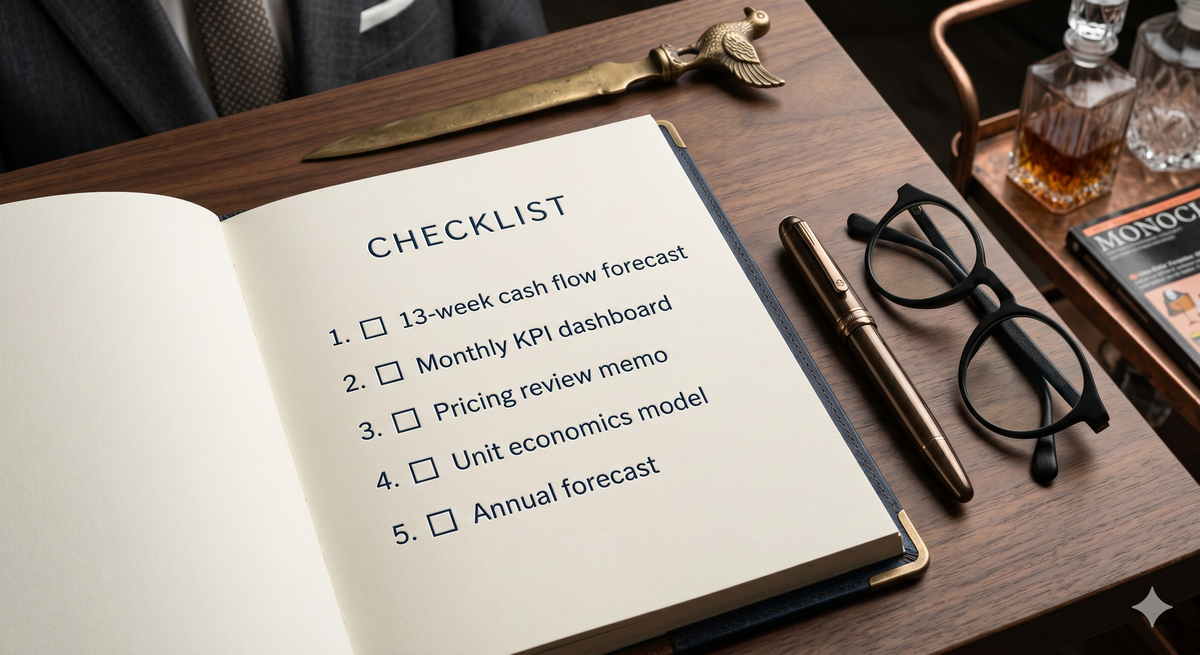
- 13-week cash flow forecast: A rolling forecast that shows you exactly when your cash hits the floor and when it rebounds. Updated every week.
- Monthly KPI dashboard: One page. The metrics that matter. Updated within five business days of month-end.
- Pricing review memo: Analysis of your pricing by customer, product, or segment. Recommendations on where to move.
- Unit economics model: True cost per customer, per project, per product. This is foundational.
- Annual forecast (or quarterly projection): Built on real assumptions, updated as the year unfolds.
These deliverables are not busywork. Each one either solves a problem or opens a strategic door.
What a Fractional CFO Does NOT Do
Let's be clear about boundaries. A fractional CFO is not your accountant or bookkeeper. They don't:
- Process payroll or reconcile bank accounts
- File your taxes or manage compliance
- Run QuickBooks or manage day-to-day accounting
- Spend hours on administrative tasks
If you do not have solid bookkeeping and accounting in place, that should be your first hire. A fractional CFO sits on top of that foundation. They take clean data and turn it into strategy.
This is why fractional CFOs work best when paired with a strong accounting or bookkeeping function—either in-house, outsourced, or through a CPA firm.
Ready to make data-driven decisions? Let's talk about what your financials are hiding.
Start a conversation with our team →
The Difference You Will Feel
After four weeks with a good fractional CFO, you will feel different. Not just think differently—feel different.
You will stop making decisions based on intuition and start making them based on data. You will know your cash position three months out, not three days. You will understand your unit economics deeply enough to talk pricing with confidence. You will see the levers in your business—where to push, where to hold.
Most importantly, you will stop wondering if your business is actually working. You will know.
"The best businesses are built on clarity. A fractional CFO is how you get there."
FAQ
Q: How many hours per week does a fractional CFO typically work on my account?
A: It depends on your size and complexity, but typically 10-20 hours per week for a growing business. This includes meetings, modeling, dashboard updates, and strategic work. You should get a clear hours commitment in your engagement.
Q: Do I still need a bookkeeper if I hire a fractional CFO?
A: Yes. A fractional CFO works with clean data. Your bookkeeper or accounting function handles transaction entry, reconciliation, and compliance. The fractional CFO turns that clean data into strategy.
Q: What is the difference between a fractional CFO and a business advisor?
A: A fractional CFO is financial-first. They build models, own cash flow forecasts, and ground strategy in numbers. A business advisor might be broader but may lack the financial depth. Often, you want both.
Q: Can a fractional CFO help with fundraising?
A: Absolutely. They can build financial models that show investors your path to profitability, help you understand what numbers matter to investors, and often advise on valuation and terms.
Q: How do I measure if my fractional CFO is adding value?
A: Look for tangible outcomes: price increases landed, unprofitable customer relationships addressed, cash position clarity, or faster month-end close. A good fractional CFO makes their work visible and measurable.
A fractional CFO is not a luxury. For service businesses scaling from $1M to $20M, they are often the most leveraged hire you can make. The week looks exactly like this: cash flow clarity, KPI focus, pricing strategy, forward-looking planning, and financial modeling.
The result? A business that runs on data instead of intuition. And that changes everything.
Let's build a financial roadmap for your growth.