When to Hire a Tax Strategist vs a Tax Preparer (By Revenue and Complexity)
Tax preparers file returns. Tax strategists reduce your tax liability. The difference compounds with revenue. Here's how to assess when upgrading from a preparer to a strategist makes financial sense.

When to Hire a Tax Strategist vs a Tax Preparer (By Revenue and Complexity)
Most service firm owners work with a tax preparer. This person (or firm) handles your books, prepares your return, files quarterly estimates, and answers basic tax questions. They're essential. But there's a significant gap between what a tax preparer does and what a tax strategist does—and that gap costs thousands annually once your revenue exceeds a certain threshold.
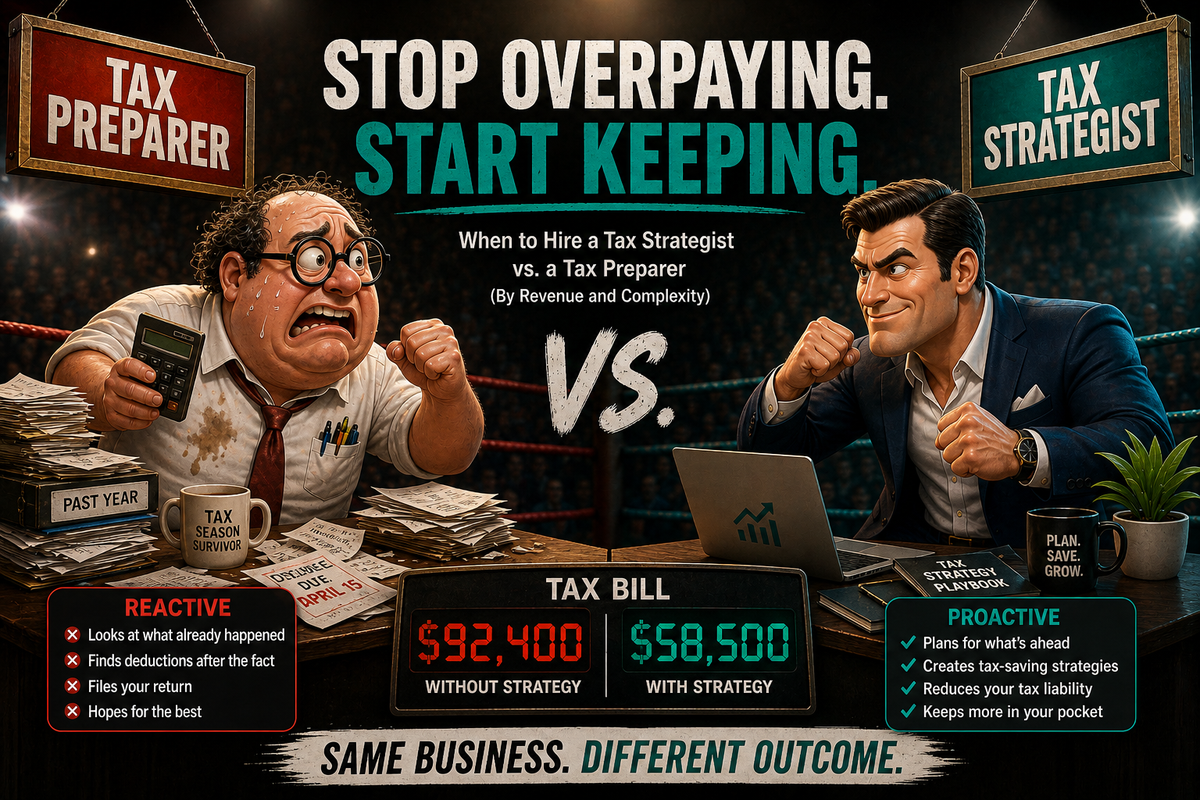
A tax preparer asks: "What did you earn last year?" Then they file the return and collect the fee. A tax strategist asks: "How much will you owe next year, and how can we reduce it?" Then they structure decisions throughout the year to lower liability. The difference is proactive vs. reactive.
This guide explains the distinction, outlines when each makes financial sense, and maps the revenue thresholds where upgrading from preparer to strategist becomes a high-ROI investment.
The Tax Preparer: Compliance-Focused
Tax preparers handle compliance: filing tax returns, calculating quarterly estimates, documenting deductions, and ensuring you don't break the law. This is essential work. But it's not tax planning.
What a Tax Preparer Does
- Collects financial information (P&L, balance sheet, expense receipts)
- Categorizes income and expenses
- Calculates taxable income based on what already happened
- Files the tax return (1040, 1120-S, 1065)
- Files quarterly estimated tax payments
- Responds to basic tax questions (am I deducting correctly? should I hire someone? etc.)
- Handles year-end bookkeeping cleanup
Cost: $500-$3,000/year depending on complexity (self-employed sole proprietor to small S-Corp).
Timeline: Preparer work is primarily done November-April (year-end planning and return preparation).
Limitation: The preparer is reacting to your year-end numbers. If you earned $500,000 and your preparer calculates tax liability of $140,000, they're obligated to report that. They can't easily say, "Next year, avoid this" because next year hasn't happened yet.
The Tax Strategist: Proactive Planning
Tax strategists are different. They operate year-round, not just at tax time. Their role is to monitor your business, identify tax opportunities, and structure decisions before they're made—not after.
What a Tax Strategist Does
- Quarterly or monthly business reviews and projections
- Year-round tax opportunity identification
- Entity structure optimization (S-Corp vs. sole prop, C-Corp elections, etc.)
- Deduction discovery and maximization
- Proactive tax planning (timing income, accelerating deductions, strategic retirement contributions)
- Complex transaction guidance (acquisitions, dispositions, restructurings)
- Coordinated strategy across business and personal tax situations
- CFO-level financial and tax counsel
Cost: $3,000-$15,000/year for smaller firms, often $200-$500/month on retainer for larger ones.
Timeline: Strategists work throughout the year, not just at tax time.
Focus: Strategists reduce tax liability before it's owed. If a strategist projects $140,000 tax liability, they spend the next 9 months identifying ways to reduce it to $120,000 or $100,000. The preparer files based on results; the strategist shapes those results.
"A tax preparer costs you $2,000 and saves you $0. A tax strategist costs you $10,000 and saves you $30,000. The ROI is obvious, but it's invisible if you don't hire a strategist first."
Comparing the Two: A Real Example
The Firm: A consulting company, $800k revenue, S-Corp, one owner.
Tax Preparer Scenario:
- Year-end: preparer calculates taxable income of $280,000
- Applies 33% effective rate (federal + state + self-employment): $92,400 tax liability
- Owner pays the bill
- Preparer fee: $1,200
- Total cost: $93,600
Tax Strategist Scenario:
- Q2 projection: identifies $280,000 projected income
- Recommends: (a) increase W-2 wages by $50k instead of taking distribution (saves 15% SE tax = $7,500), (b) purchase $30k office equipment before year-end ($30k x 33% = $9,900 savings), (c) contribute $20k to Solo 401k ($20k x 33% = $6,600 savings)
- Implements strategies throughout Q3-Q4
- Year-end taxable income reduced to $180,000 (due to W-2 deduction and equipment deduction, net of additional W-2 taxes owed)
- New tax liability: $58,500 (~68% reduction)
- Strategist fee: $8,000 (annual retainer)
- Total cost: $66,500
Bottom line: Strategist cost more ($6,800 additional fee) but saved $34,900 in taxes. Net benefit: $28,100 to the owner. ROI on strategist fee: 351%.
Revenue Thresholds: When to Upgrade
$0-$200,000 Revenue: Use a Tax Preparer
At this stage, you likely don't have complex tax planning opportunities. A qualified preparer who ensures proper categorization and deductions is sufficient. Cost: $500-$1,200/year.
Preparer responsibilities: Proper entity choice, basic deduction capture, quarterly estimates.
Red flag for upgrade: If your profit margin is consistently above 40%, you have tax planning opportunity. Consider a strategist even at lower revenue.
$200,000-$500,000 Revenue: Hybrid Approach
At this stage, the tax planning opportunity emerges. You're profitable enough that tax liability is material, but not complex enough for full-time CFO-style oversight.
Recommendation: Use a hybrid model. Hire a part-time strategist (10-15 hours/quarter, ~$3,000-$6,000/year) who works with your preparer. They do quarterly reviews and opportunity identification, while the preparer handles execution and filing.
Expected ROI: 200-300% (for every $1 spent on strategy, save $2-3 in taxes).
$500,000-$1,500,000 Revenue: Tax Strategist Becomes Essential
At this revenue level, a tax preparer alone is insufficient. You need year-round strategic guidance. The tax savings available typically exceed $20,000-$40,000 annually with proper planning.
Recommendation: Hire a dedicated tax strategist on retainer, $6,000-$12,000/year (or $500-$1,000/month).
Expected ROI: 300-400% (for every $1 spent, save $3-4 in taxes).
$1,500,000+ Revenue: Full Tax and Financial Strategy
Beyond $1.5M, you need more than a tax strategist. You need integrated CFO-level financial planning, cash flow management, capital structure strategy, and tax coordination. This often requires a fractional CFO or internal controller who oversees a tax strategist.
Recommendation: Fractional CFO ($2,000-$4,000/month) plus tax strategist ($1,000-$2,000/month), or full-time controller ($80,000-$120,000/year) who coordinates with external strategist.
Expected ROI: 400-600% (for every $1 spent on strategy and financial planning, save $4-6 in taxes and operational inefficiency).
The Cost-Benefit of Tax Strategy
Here's a rough model:
| Revenue Range | Annual Tax Liability | Tax Planning Savings Potential | Recommended Advisor Cost | Net ROI |
|---|---|---|---|---|
| $100k-$200k | $20k-$40k | $2k-$5k (5-10%) | $800 | 150-500% |
| $200k-$500k | $40k-$120k | $8k-$25k (10-20%) | $3,500 | 130-700% |
| $500k-$1.5M | $120k-$400k | $25k-$80k (15-25%) | $9,000 | 180-800% |
| $1.5M-$5M | $400k-$1.5M | $80k-$300k (20-30%) | $24,000 | 230-1200% |
Key insight: The higher your revenue and profit, the higher your ROI on tax strategy. It's not just a cost of doing business; it's an investment that compounds with scale.
How to Evaluate a Tax Strategist
Not all professionals calling themselves "strategists" are created equal. Here's how to vet one:
Question 1: How Often Do You Review My Numbers?
Good answer: "Monthly or quarterly, depending on your preference and complexity. We'll do at least quarterly projections and adjusted planning discussions."
Bad answer: "At tax time. We'll see what your numbers look like and file accordingly."
Question 2: Can You Explain a Specific Tax Opportunity You'd Recommend for My Business?
Good answer: They've thought about your specific situation and can articulate concrete planning ideas (entity structure, deduction strategies, retirement optimization). They show curiosity about your business model and ask follow-up questions.
Bad answer: Generic advice ("You should contribute more to retirement" or "You might want to form an S-Corp") without understanding your specific situation.
Question 3: What's Your Fee Structure?
Good answer: Clear, upfront pricing (hourly, monthly retainer, or flat fee) with clarity on what's included. No surprises.
Bad answer: Vague pricing, percentage of tax savings (creates conflict of interest), or waiting to see complexity.
FAQ: Tax Preparers and Strategists
Q: Can my current tax preparer also be my tax strategist?
Sometimes, but not always. Many preparers are trained and willing to add strategic services. Ask if they do quarterly planning, proactive opportunity identification, and year-round reviews. If they're only available at tax time, they're primarily a preparer. You may need to supplement with a strategist.
Q: Is it worth upgrading to a strategist if I only save $5,000?
If the strategist costs $3,000, yes. ROI of 167% is excellent. However, find a strategist whose fees are proportional to your revenue. Don't overpay for strategy on a small base.
Q: Can I hire a strategist just to review my preparer's work?
Yes. Some owners hire a strategist for a limited engagement (2-3 hours quarterly) to identify missed opportunities and second-guess the preparer's approach. It's cost-effective if you trust your preparer but want a second opinion.
Q: What's the difference between a tax strategist and a CPA?
Not everyone with the "strategist" title is a CPA. CPAs are licensed and regulated. Tax strategists may or may not be CPAs. Look for CPAs with tax planning specialization, or strategists with clear credentials and experience in your industry.
Q: If I hire a strategist and they miss an opportunity, am I liable?
Strategists typically have E&O insurance and are held to a professional standard of care. If they fail to identify an obvious opportunity that a reasonable tax professional would have caught, you may have recourse. Always clarify scope of services in writing.
Making the Upgrade
If you're at $300,000+ revenue and have never worked with a tax strategist, the ROI is compelling. Start with a consultation: explain your situation, ask about specific opportunities, and assess whether the strategist's recommendations justify the fee.
Most firms find that the upgrade to strategic planning pays for itself in the first year and compounds every year thereafter. What you save in taxes reinvested in growth creates compounding value.
The choice isn't whether you can afford a tax strategist; it's whether you can afford not to have one.
Start Tax Strategy Planning
Let's assess your specific situation and identify tax planning opportunities. We'll model the impact of strategic changes and show you the ROI before you commit to anything.