CPA vs EA vs Tax Preparer: Who Should You Actually Hire?
Not all tax professionals are the same. CPAs, enrolled agents, and tax preparers have different credentials, legal scope, and expertise. Understanding these distinctions helps you hire the right professional for your situation—whether you need a simple return prepared or comprehensive tax strategy.


The Credential Gap Nobody Talks About
You've prepared your financial documents and you're ready to file. But when you search for a "tax professional," you get a confusing mix of titles: CPA, EA, tax preparer, tax advisor, tax consultant. Are they all the same? Can they all help you?
The answer is no—and the differences matter. Not all tax professionals have the same legal authority, expertise, or scope of practice. Hiring the wrong one could cost you thousands in missed deductions, aggressive positions, or IRS compliance issues.
In this article, we'll break down what each credential means, what each professional can legally do, and when you should hire each one.
What is a CPA?
A Certified Public Accountant (CPA) is a professional licensed at the state level after meeting rigorous education, experience, and examination requirements. To become a CPA, you must:
- Complete at least 150 college credit hours (typically a bachelor's degree plus additional courses)
- Pass the Uniform CPA Examination across four sections
- Satisfy state-specific experience requirements (usually 1-2 years)
- Maintain continuing education annually
CPAs are regulated by their state boards of accountancy and must adhere to a strict code of professional conduct. This licensing means you have regulatory recourse if something goes wrong.
What CPAs Can Do
- Prepare and sign tax returns with personal accountability
- Audit and attest services for financial statements
- Provide tax advisory and planning for complex situations
- Represent clients before the IRS during audits and appeals
- Offer general accounting and bookkeeping services
What is an Enrolled Agent?
An Enrolled Agent (EA) is a federally recognized tax specialist credentialed by the IRS. To become an EA, you must pass the Special Enrollment Examination (SEE), a comprehensive three-part exam covering federal tax law, or have significant IRS experience. EAs do not need state licensing, but they must maintain a Preparer Tax Identification Number (PTIN) and complete annual continuing education.
EAs are highly trained in tax law but lack the broader scope of general accounting that CPAs offer. Many EAs specialize exclusively in tax preparation and representation, making them excellent for businesses that only need tax services.
What Enrolled Agents Can Do
- Prepare and sign tax returns with personal accountability
- Represent clients before the IRS during audits and appeals
- Provide tax planning and advisory within their expertise
- Handle estimated quarterly tax payments and compliance
What EAs cannot do: They cannot perform audits, attests, or general accounting services. If you need financial statement auditing or comprehensive bookkeeping, you'll need a CPA.
What is a Tax Preparer?
A tax preparer (sometimes called a "tax return preparer" or "tax return specialist") is the most loosely regulated category. In most states, anyone can call themselves a tax preparer with no credential, license, or formal education requirement. Some tax preparers have credentials like the Certified Tax Preparer (CTP) or Registered Tax Return Preparer (RTRP), but these are not required.
Tax preparers who handle federal returns must have a PTIN, but this is an administrative identifier—not a credential proving competence. A PTIN simply shows the IRS that you filed a return.
What Tax Preparers Can Do
- Prepare tax returns (though accountability varies by credential)
- File returns and handle basic tax compliance
What they cannot do: Tax preparers cannot represent you before the IRS (unless they hold a CPA or EA credential), cannot provide tax planning, and cannot sign returns in many jurisdictions. More importantly, if the preparer makes an error, your recourse is limited because they may not carry malpractice insurance or adhere to professional standards.
"Choosing a tax professional based on price alone is like choosing a surgeon based on who charges the least. The credential gap isn't just about qualifications—it's about accountability."
The Cost Difference
You'll typically pay more for a CPA than an EA, and more for an EA than a tax preparer. But this isn't just about credential markup—it reflects the scope of service and liability risk.
- Tax Preparer: $150–$400 for a simple return; no advisory capability
- Enrolled Agent: $300–$800; includes tax planning and IRS representation
- CPA: $400–$1,500+; includes planning, representation, and general accounting
The right choice depends on what you actually need—not just what you want to spend.
When to Hire a Tax Preparer
A tax preparer makes sense if:
- You have a simple W-2 income and standard deductions
- You have minimal deductions and no business activity
- Your situation is unlikely to change year to year
- You don't need representation or planning
Cost is low, but so is sophistication. If your tax situation becomes more complex—say, you start a side business—you'll need to upgrade.
When to Hire an Enrolled Agent
An EA is the right choice if:
- You own a small business or have self-employment income
- You need tax planning and quarterly estimated payments
- You might face an audit and need professional representation
- You want tax expertise without the general accounting services of a CPA
EAs specialize in tax law and are excellent at positioning your business for tax efficiency. They're particularly strong for S-corps, partnerships, and freelancers.
When to Hire a CPA
Hire a CPA if:
- You're running a growing business and need comprehensive planning
- You need audited or reviewed financial statements
- You're dealing with multi-state operations or complex structures
- You need ongoing bookkeeping and accounting, not just tax prep
- You want a long-term advisor for major decisions (hiring, expansion, sale)
A CPA can be your entire accounting department. They provide audit services, strategic advisory, and representation—all under one professional standard and license.
The "CPA Who Doesn't Plan" Problem
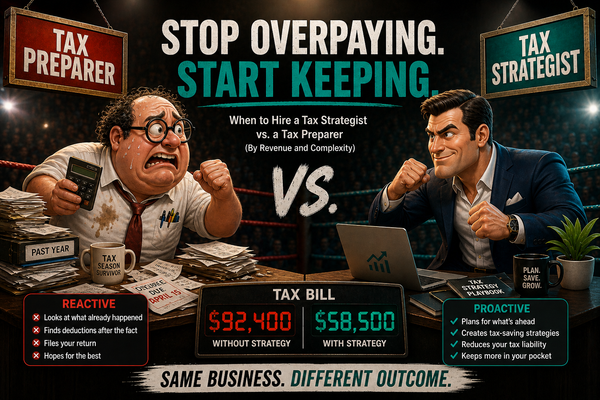
Not all CPAs are created equal. Some CPAs prepare returns competently but never discuss strategy. They'll prepare your tax return accurately—but they won't tell you that restructuring your entity would save $15,000 per year, or that you're missing legitimate deductions.
When you hire a CPA, ask:
- "What tax planning opportunities do you typically find for clients like me?"
- "Do you review my business strategy, or just file my return?"
- "How do you stay on top of changes to tax law that affect my industry?"
A good CPA proactively identifies planning opportunities. If your CPA only files your return and never asks about your business goals, you're paying CPA prices for preparer-level service.
How to Verify Credentials
Before hiring, verify that the professional actually has the credential they claim:
- CPAs: Check your state's CPA board website. Search by name or license number to confirm active status.
- Enrolled Agents: Check the IRS Directory of Enrolled Agents at irs.gov or search by PTIN.
- Tax Preparers: Ask for proof of PTIN and any certifications. A PTIN alone is not a credential—it's just a filing identifier.
Anyone can claim credentials. Verification takes two minutes and protects you from fraudsters.
FAQ: CPA vs EA vs Tax Preparer
Can an EA do everything a CPA can do?
No. EAs can prepare returns and represent clients before the IRS, but they cannot perform audits, attestations, or general accounting services. If you need your financial statements audited, you need a CPA.
Is a CPA always better than an EA?
Not necessarily. For tax preparation and planning, an EA is often more specialized and potentially more cost-effective. The question is what services you need, not which credential is "better." A great EA beats a mediocre CPA.
What happens if my tax preparer makes a mistake?
It depends on whether they carry malpractice insurance and maintain professional standards. Tax preparers without credentials often have no insurance and no recourse mechanism. CPAs and EAs carry professional liability insurance and are bound by code of conduct standards.
How do I know if a professional will do tax planning?
Ask directly. Say: "I'm looking for someone who will identify tax opportunities and optimize my return, not just fill in forms." A planning-focused professional will discuss strategy in the first consultation. If they just want to gather documents and file, keep looking.
Can a tax preparer represent me at an IRS audit?
Only if they hold a CPA or EA credential (or are a lawyer). A tax preparer without credentials cannot represent you before the IRS, even if they prepared your return. You'd need to hire a CPA or EA separately for representation.
Ready to Hire the Right Tax Professional?
At Taxstra, our CPAs combine tax expertise with comprehensive business advisory. We don't just file your return—we identify opportunities to reduce your tax burden and support your growth.
Explore our tax planning services today and find out how strategic advisory can transform your bottom line.