What a Proactive Tax Advisor Does (That Your Current CPA Does Not)
The gap between a tax preparer and a tax advisor is tens of thousands of dollars a year. Here is what you are missing.


You hired a CPA. You send them documents. They file your return in March or April. You get a bill. End of story.
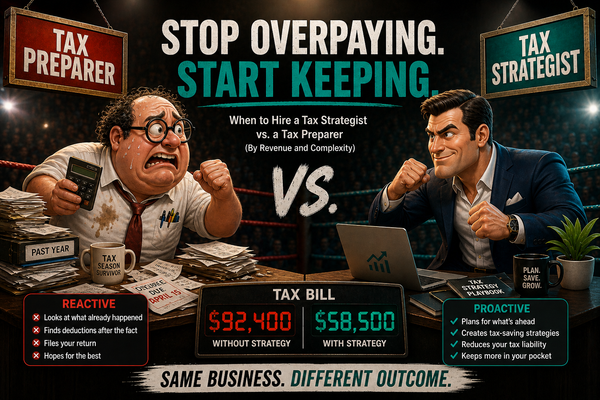
That's not tax advice. That's tax preparation. And the gap between the two? It could be $20,000 to $100,000+ a year in taxes you're overpaying.
A proactive tax advisor operates in an entirely different universe. They're not waiting for April 14th to start thinking about your taxes. They're already three moves ahead, orchestrating strategy every single month of the year. They see opportunities where a reactive CPA sees only compliance.
Here's exactly what that looks like—and why it matters to your bottom line.
The Reactive CPA Default
Let's be honest: most CPAs are order-takers. They're not incentivized to challenge the status quo or dig deeper. Here's the typical reactive model:
- December: Clients panic and call with last-minute "tax saving" ideas. Too late for most of them.
- January–March: Gathering documents, organizing files, waiting for K-1s and 1099s.
- April: Filing the return based on what happened during the year—not what could have been planned.
- May–December: Radio silence. No strategy, no optimization, no planning.
The reactive model treats tax as a consequence of doing business. Not a variable to optimize.
Worse, it creates a false sense of security. Your CPA filed your return correctly? Great. But were you supposed to owe that much in the first place? A reactive CPA will never tell you. They'll just file what's required and send an invoice.
And yet, most business owners and self-employed professionals accept this as normal. They assume everyone does it this way.
They're wrong.
What Proactive Actually Means
A proactive tax advisor flips the entire model on its head. Instead of reacting to last year's numbers, they're designing the current year to optimize next year's outcome.
This isn't aggressive tax evasion or shady schemes. It's strategic decision-making, informed by actual tax law. It means:
- Quarterly planning meetings to review progress, identify trends, and adjust strategy before it's too late.
- Real-time entity structure optimization. Should you be an S-Corp? An LLC? A C-Corp? A proactive advisor answers this based on your specific situation—not a one-size-fits-all template.
- Expense timing and categorization that maximizes deductions without exposing you to audit risk.
- Income acceleration or deferral strategies based on projected year-end numbers and tax law changes.
- Retirement plan design that actually saves taxes, not just accumulates money.
- Estimated tax management so you're not blindsided in April—and not overpaying the IRS all year.
Most CPAs file your return and call it a day. A proactive tax advisor spends 11 months making sure you don't have to pay the full amount.
It requires communication. A proactive advisor isn't waiting for you to call in December. They're checking in monthly. They're sending analysis. They're asking questions about business decisions before you make them—because some decisions have massive tax implications.
The difference between a tax strategist and a CPA comes down to this: one waits for results to file a return. The other shapes results to optimize the return.
A Month-by-Month Look
Here's what a proactive year actually looks like:
January – Goal Setting & Structure Review
Before the year really gets rolling, a proactive advisor is asking:
- Is your current entity structure still optimal? Have earnings changed? Tax laws shifted?
- What are your income projections for the year?
- Are there any retirement plan contributions we should make while the year is young?
- What deductions are we planning for? (Travel, equipment, home office improvements?)
The goal is to establish a baseline and identify any low-hanging fruit before January closes.
February – Quarterly Strategy Review & Documentation
You've had a month of actual business data. Time to see if reality matches projections.
- Are you tracking to your income projections?
- Is your estimated tax liability on track?
- Are there any unexpected deductions to plan around?
- What's your current margin? Have expenses changed?
March – Q1 Estimated Tax Planning
Before Q1 estimated taxes are due (April 15th), a proactive advisor has already calculated your liability and structured payments to avoid penalties while minimizing overpayment.
They're also looking at how to reduce future quarters based on Q1 results.
April – Return Filing & Mid-Year Strategy
Yes, you're filing the prior year's return. But a proactive advisor uses this as a teaching moment. They show you:
- What you paid in taxes (and why)
- What opportunities you missed (and how to catch them in Q2)
- What's coming in estimated taxes (and how to structure Q2 to reduce it)
This isn't a transactional conversation. It's educational and forward-looking.
May – Equipment & Depreciation Planning
Mid-year is the sweet spot for business equipment purchases. A proactive advisor is helping you understand:
- Section 179 deductions and bonus depreciation strategies
- Cost segregation opportunities if you've invested in real property
- Equipment leasing vs. buying tax implications
Proactive strategy conversations often uncover equipment that should have been purchased months ago—or timing adjustments for purchases planned in Q4.
June – Q2 Estimated Tax Adjustment
Another checkpoint. Is the year tracking to projections? Do estimated tax payments need adjustment? Are there any income opportunities or unexpected expenses changing the picture?
July – Mid-Year Financial Review & Projection Update
You're halfway through the year. A proactive advisor pulls the full financial picture and updates year-end projections. This is often when significant strategy shifts happen because you have real data, not guesses.
August – Strategic Withdrawal & Distribution Planning
If you're an S-Corp, LLC, or partnership, this is when proactive planning around distributions matters. You want to ensure you're taking enough to cover estimated taxes without creating unnecessary payroll.
September – Q3 Tax Planning & Entity Review
Q3 estimated taxes are due October 15th. Before that, a proactive advisor is:
- Finalizing Q3 estimates with updated year-end projections
- Identifying any Q4 expenses that should happen now (or vice versa)
- Reviewing whether your current structure still makes sense
October – Year-End Planning Sprint Begins
This is the most critical month. Q4 decisions have the biggest tax impact. A proactive advisor is working through:
- Bonus and retirement plan contribution timing
- Equipment purchases (Section 179 and bonus depreciation deadlines)
- Income deferral strategies if year-end projections are higher than expected
- S-Corp optimization for owners taking distributions
November – Q4 Estimated Tax & Compliance Preparation
Q4 estimated taxes are due January 15th of the following year, but a proactive advisor isn't waiting until December to calculate them. They're working with updated financials now.
They're also starting to gather the documentation and prepare the infrastructure for smooth January filing.
December – Year-End Close & Strategy Summary
The year is closing. Final decisions on bonuses, distributions, and contributions happen now. A proactive advisor is ensuring every decision is optimized for tax efficiency.
They're also preparing a year-end summary: here's what we did, here's what it saved you, and here's what we're planning for next year.
The difference isn't complicated. One approach asks: "What did you earn?" The other asks: "How can we structure what you earn to keep more of it?"
The Financial Impact
You're probably wondering: does this actually matter? How much money are we talking about?
Consider a business owner earning $200,000 per year:
- Reactive CPA: Files the return as-is. Likely federal and self-employment tax burden: ~$60,000–$70,000.
- Proactive Advisor: Optimizes entity structure (maybe S-Corp makes sense), structures retirement contributions, times equipment purchases, coordinates distributions. Likely tax burden: ~$45,000–$50,000.
That's a $15,000–$20,000 difference on $200,000 in income. Scale that to a $500,000 business and you're looking at $40,000–$60,000 in annual tax savings.
Those aren't unusual numbers. Many business owners are actually overpaying their CPAs because they're not getting strategic advice—just compliance work.
And here's the kicker: you're paying for compliance either way. The question is whether you're also getting strategy.
How to Know If You Have One
Not sure if your current advisor is proactive or reactive? Ask yourself:
- Do they contact you quarterly, or do you contact them once a year?
- Have they ever asked about your business decisions before you made them?
- Can they tell you your estimated tax liability in June (not just April)?
- Have they ever suggested a strategic change based on your numbers, or do they only file what you give them?
- Do they actively provide tax planning services, or do they just do tax prep?
- Can they explain why your entity structure is optimal for your situation (not just "that's what you have")?
If you're answering "no" to most of these, you have a reactive tax preparer. Not a proactive advisor.
Making the Switch
Changing advisors feels risky. You've probably built a relationship. But consider this: staying with a reactive advisor is actually the riskier choice. You're leaving money on the table every single year.
If you're interested in what proactive tax strategy actually looks like for your specific situation, the best first step is a conversation. Not about last year. About next year and how to optimize it.
Schedule a 30-minute tax strategy session to explore what's actually possible for your business. We'll review your current situation, identify missed opportunities, and show you exactly how much a proactive approach could save you.
FAQ
What's the difference between a tax advisor and a CPA?
All tax advisors can be CPAs, but not all CPAs are tax advisors. A CPA credential means you're qualified to do tax prep and accounting work. A tax advisor specifically focuses on tax strategy and optimization—helping you understand how decisions impact your tax liability and structuring those decisions accordingly. A true tax strategist works year-round, not just during tax season.
Can I do tax strategy with a bookkeeper instead of a CPA?
Bookkeepers are excellent at what they do—organizing and recording transactions. But tax strategy requires deep knowledge of tax law, entity structures, and optimization opportunities. That's a CPA or tax attorney's domain. You want someone licensed and insured for the tax advice they're giving you.
How much does a proactive tax advisor cost?
Proactive tax advisory typically costs more than reactive tax prep—but far less than the taxes you'll save. Many proactive advisors charge flat retainers ($2,000–$10,000+ annually depending on complexity) rather than hourly rates. The investment almost always pays for itself multiple times over.
When should I start thinking about tax strategy for next year?
Now. Seriously. Tax planning is most effective when you start early in the year—not in December. The earlier you engage with strategy, the more options you have to optimize.
What if I change advisors mid-year?
It's not ideal timing-wise, but it's absolutely doable. Many business owners make the switch in September or October, which still gives you Q4 to implement strategy. Your new advisor can work with your existing financial data and make meaningful changes before year-end.
Ready to stop overpaying taxes and start actually using tax strategy? Book a 30-minute strategy call with our team. We'll show you exactly where you're leaving money on the table and what's possible when you have a truly proactive advisor in your corner.
Because the gap between filing a return and optimizing your taxes isn't luck. It's strategy. And it's available to you.