How to Find a Good CPA for Your Small Business: 12 Questions That Expose Amateurs
Most CPAs will take your money. Few will actually save you any. Here's how to tell the difference before you sign.


You're sitting across from a potential CPA for your business. Their office looks professional. They have impressive credentials on the wall. They speak with authority. You're ready to hire them.
But here's what you don't know yet: they might spend the entire year siloing data into spreadsheets, file your taxes on April 14th, and miss five opportunities to save you money that were sitting in plain sight.
Most business owners treat CPA selection like choosing a car—they check a few boxes and assume all qualified professionals deliver the same value. They don't. The difference between a good CPA and a mediocre one isn't their credentials. It's their philosophy.
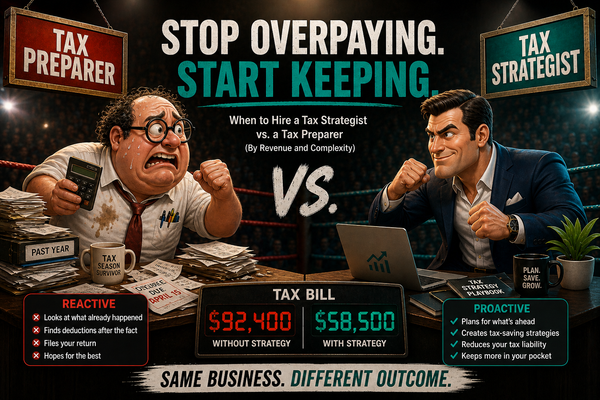
A mediocre CPA is reactive. They wait for you to bring them receipts. They file your return. They collect their fee. A good CPA is proactive. They're thinking about your business strategy year-round, identifying tax issues before they become problems, and building a plan that actually saves you money.
How do you tell which is which before you sign? Ask the right questions. Here are twelve that will expose whether you're talking to a true tax strategist or someone who's essentially a glorified data entry clerk.
1. Can I Have Your Cell Phone Number?
What a good answer looks like: They give it to you or provide a clear protocol for urgent issues. They set boundaries about when it's appropriate to call, but they're accessible. A truly responsive CPA knows that tax deadlines don't care about business hours.
What a bad answer looks like: They suggest you only email, or they say you can call their office and leave a message. They treat their time like it's infinitely more valuable than yours. If they're not accessible during critical moments, they're not your CPA—they're a filing service.
The cell phone question isn't really about your ego. It's about whether this person is willing to be genuinely available when your business needs them. A CPA who won't give you their direct line is signaling that their relationship with you is transactional, not partnership-oriented.
2. Do You Do Tax Planning or Just Tax Filing?
What a good answer looks like: They talk about tax planning as a separate service throughout the year. They discuss specific strategies like entity structure optimization, quarterly estimated taxes, and year-end opportunities. They explain how planning in March differs from planning in December.
What a bad answer looks like: They say, "We do tax planning as part of the filing process," or they describe planning as something that happens right before you file. They can't articulate what they actually do beyond number-crunching come tax season. This is the answer you get from a tax preparer, not a CPA.
This single question separates the professionals from the order-takers. A CPA who only files taxes is leaving money on the table. They're not thinking strategically about your business structure, your income timing, or how changes in tax law affect you. If they can't describe a proactive planning engagement, move on.
3. What's Your Fee Structure?
What a good answer looks like: They're transparent and specific. They might charge a flat fee for a standard return, hourly rates for planning work, or a value-based fee that scales with the complexity and savings generated. They explain what's included and what costs extra. They're willing to quote projects upfront.
What a bad answer looks like: Vague language like "it depends on complexity" without any framework for determining complexity. They dodge the question and want to "discuss it after the initial meeting." They charge only per-hour with no estimate. They're hiding something or they genuinely don't know.
Bad fee structures often signal bad work. If a CPA can't be transparent about money upfront—the one thing that should be completely clear—how are they handling your financial data? Also, if they're billing purely hourly, they have an incentive to make everything complicated and time-consuming.
4. How Many Times a Year Do We Meet or Talk?
What a good answer looks like: They recommend at least quarterly touchpoints for any business doing more than basic filing. They discuss strategic planning meetings, interim check-ins, and proactive communication about deadline dates and opportunities. They treat the relationship as ongoing, not once-a-year.
What a bad answer looks like: "Just bring me your information in April," or they suggest an annual meeting. They only want to communicate when you initiate. They're clearly not planning to do any actual planning work.
The frequency of contact tells you everything about their engagement level. A CPA who only talks to you once a year is not monitoring your business, identifying trends, or catching problems early. They're waiting passively for you to hand them your year in a shoebox.
5. What's Your Experience With My Industry?
What a good answer looks like: They can name specific clients in your industry, or at least nearby industries. They understand your unique tax challenges—contractors deal with different issues than e-commerce businesses, which deal with different issues than service professionals. They speak knowledgeably about your margins, deductions, and typical tax positions.
What a bad answer looks like: They say "we work with all kinds of businesses," or "tax strategy is the same regardless of industry." They can't name a single specific client or challenge. They treat your business like a generic filing job.
Industry expertise matters enormously. A CPA who specializes in real estate will structure a real estate business very differently than one who's never worked with a property investor. Generalists often miss specialized deductions and strategies that are standard in specific industries.
6. Do You Recommend a Specific Business Entity Structure?
What a good answer looks like: They ask about your revenue, profit margins, retirement goals, risk profile, and state location before making a recommendation. They discuss trade-offs between S-Corp, C-Corp, LLC, sole proprietorship, and partnership structures. They mention checking with your CPA before making business decisions. They can explain why a structure works, not just that it does.
What a bad answer looks like: They recommend everyone form an LLC or everyone use an S-Corp. They haven't asked any qualifying questions. They can't explain the specific tax implications. They're pushing you toward the structure they most commonly file.
Your entity structure is one of the highest-leverage tax decisions you'll make. A true CPA evaluates your specific situation before recommending a structure. A true amateur applies cookie-cutter solutions to everyone.
7. Have You Ever Recommended a Client Fire You?
What a good answer looks like: They have an example—maybe once they realized a different CPA specialized in a particular niche better suited to the client, or the client's business had changed and the fit no longer made sense. They prioritize what's best for the client over the retention of the fee.
What a bad answer looks like: They say no, or they look confused. They imply their service is valuable to every client at every stage. They've never thought about whether they're actually the best fit.
This question separates practitioners who have genuine client relationships from transactional service providers. A CPA who's never recommend a client leave is either servicing a very narrow client base or prioritizing revenue over client welfare. Good CPAs occasionally realize they're not the best fit—and they say so.
8. How Do You Stay Current With Tax Law Changes?
What a good answer looks like: They subscribe to continuing education, attend professional conferences, maintain certifications, and participate in peer networks. They can cite recent changes and discuss how those changes affect your business. They have a system for keeping you informed about developments that matter to you.
What a bad answer looks like: Vague comments about "reading updates." They can't name a specific recent tax change. They seem surprised when you mention something you read about. They don't have a formal education plan.
Tax law changes constantly. A CPA who isn't systematically staying current is working with a playbook from 2015. It's not enough to have gotten something right in the past—they need to be actively learning. This is non-negotiable.
9. How Much of Your Work Is Billable Advisory vs. Filing/Compliance?
What a good answer looks like: They can tell you their approximate breakdown, and advisory makes up a meaningful portion—ideally 30-50% or more. They're spending significant time thinking strategically, not just processing tax forms. They distinguish between reactive compliance work and proactive planning work.
What a bad answer looks like: They're almost entirely compliance and filing. They can't separate advisory work from compliance work. They're literally just processing returns with no strategic thinking built in.
If 95% of a CPA's time is spent on tax filing and compliance, that's a tax preparation firm. Nothing wrong with that—if that's what you need. But if you're looking for a true CPA who will actually save you money through tax planning and strategic advice, you need someone whose business model includes substantial advisory work.
10. What Would You Change About My Current Tax Situation?
What a good answer looks like: After reviewing your last return and learning about your business, they identify 2-4 specific items they'd address. They explain the rationale. They might suggest evaluating your entity structure, implementing quarterly tax planning, changing how you're handling deductions, or adjusting your retirement savings strategy.
What a bad answer looks like: They say everything looks fine, or they can't answer without looking at everything first. They don't notice any issues. They're not even trying to add value at the initial consultation.
A competent CPA can spot issues quickly. If they can't identify at least one area of improvement in your situation after a 30-minute conversation, they're either not paying attention or not equipped to see tax inefficiencies. Red flag.
11. Can You Provide References From Clients in My Revenue Range?
What a good answer looks like: They provide 2-3 references who are happy to talk about their experience. The references speak about proactive planning, responsiveness, and tangible tax savings. They're businesses similar in size to yours.
What a bad answer looks like: They refuse, say all their clients are confidential, or the references they provide are either much larger or much smaller than your business. Their references can't speak specifically about planning and savings.
References matter. Talk to them. Ask what the CPA actually saved them, how responsive they are, and whether they'd recommend them. A CPA worth working with will have enthusiastic references who can point to specific value.
12. What's Your Philosophy on Aggressive vs. Conservative Tax Positions?
What a good answer looks like: They discuss balancing optimization with compliance. They take defensible tax positions but won't push you into anything audit-risky. They explain their framework for determining what's reasonable. They mention consulting the IRS guidelines and maintaining documentation.
What a bad answer looks like: They're either too conservative ("let's just file safely") or too aggressive ("here's how we can get away with this"). They don't have a clear principle. They make decisions based on whim rather than strategy.
You want a CPA who understands that there's a spectrum. You can be tax-efficient without being reckless. You can optimize without fabricating deductions. A good CPA knows where the line is and helps you stay on the right side of it. They're comfortable discussing quarterly tax planning and documentation, not just magic deductions.
"Most CPAs will take your money. Few will actually save you any. The difference is philosophy, not credentials."
The Follow-Up: What You Should Do After These Questions
You've asked the right questions. Now pay attention to how they answer, not just what they answer. Do they seem defensive? Are they educating you or just giving answers? Are they thinking about your business or just checking boxes?
After these conversations, you should have a clear sense of whether you're talking to someone who will be proactive or purely reactive. The best CPAs will make you feel like they're genuinely interested in your success, not just your tax return. They'll ask you questions about your business goals, your growth plans, and your concerns.
A CPA who only wants to know about your tax situation is missing the point. Your taxes are a function of your business. A good CPA wants to understand your business so they can optimize your taxes. That's the fundamental difference between someone who's merely competent and someone who's truly valuable.
If a prospect can answer most of these questions clearly and specifically, you're probably in good hands. If they dodge questions, get defensive, or can't articulate a philosophy beyond "we do good work," keep looking.
Ready to work with a CPA who actually thinks strategically about your business?
Schedule Your 30-Minute Consultation
The Questions That Matter Most
If you only ask three of these questions, make them the ones that matter most: Do you do tax planning or just filing? How many times a year do we talk? What would you change about my current situation?
These three cut to the core. They tell you whether the person is a strategist or a filer, whether they're engaged or hands-off, and whether they're actually paying attention to your situation.
Everything else flows from there. A CPA who plans, stays involved, and actually notices problems in your situation has already proven they're worth talking to further. The importance of proactive tax planning can't be overstated—it's usually the difference between a CPA who saves you money and one who costs you money.
"A competent CPA can spot issues quickly. If they can't identify at least one area of improvement after 30 minutes, they're not paying attention."
What Happens Next?
After you've interviewed a few CPAs using these questions, you'll start noticing patterns. The good ones will stand out. They'll articulate a clear philosophy. They'll ask you thoughtful questions. They'll demonstrate knowledge and engagement. They'll make you feel like a valued client, not a file number.
The mediocre ones will blend together. They'll give safe answers. They won't ask much about your business. They'll seem eager to take you on as a client but not particularly interested in your success. They'll treat you like every other client.
Trust your instinct after these conversations. You're hiring not just someone to file your taxes, but someone who will significantly influence your financial decisions and tax outcomes. This is someone you'll likely work with for years. The fit matters.
And remember: the cheapest CPA is rarely the best CPA. A CPA who costs you less in fees but saves you less in taxes isn't actually cheaper. You're looking for the CPA who balances cost with strategic value. That's worth paying for.
Not sure if your current CPA is actually saving you money?
"The best CPAs will make you feel like they're genuinely interested in your success, not just your tax return."
FAQ
How long should I work with a CPA before evaluating whether they're worth keeping?
At least one full tax year if they're new to your account. If it's your second year together and you haven't seen any proactive planning suggestions, it's probably time to look elsewhere. A good CPA should demonstrate value within the first few interactions, even if the major savings come during tax planning season.
Should I fire my current CPA if they can't answer these questions well?
Not immediately, but use it as a sign to start interviewing alternatives. Switching CPAs involves some transition work, so weigh the costs. But if your current CPA consistently fails these tests, the sooner you make a change the better. You could be missing significant tax savings.
What if a CPA I like is more expensive than others?
Price alone shouldn't be the deciding factor. A more expensive CPA who saves you $10,000 annually is cheaper than a bargain CPA who saves you nothing. Look at the value-to-cost ratio, not just the cost. That said, ask the expensive CPA specifically what you're paying for—make sure it's strategic work and not just premium pricing for basic services.
Can I find a good CPA if I'm very small (self-employed or just starting)?
Yes, but you might have to look at CPAs who specialize in small business. Some CPAs have minimum revenue thresholds or won't take clients below a certain complexity level. Being transparent about your size in the initial conversation helps you find someone who actually wants to work at your scale.
What if my CPA does great tax work but isn't responsive to calls?
Responsiveness matters as much as technical skill. If they're good but unreachable, you're missing half the value of a CPA relationship. Tax planning requires ongoing communication. If they won't give you reasonable access, find someone who will. The best technical CPA is useless if you can't actually work with them.
Finding a good CPA is one of the highest-return hiring decisions you'll make for your business. Use these twelve questions to cut through the noise. Trust the ones who demonstrate genuine engagement, clear strategic thinking, and proactive planning orientation. Avoid the ones who seem purely transactional.
Your taxes are your business's financial foundation. They deserve someone who understands that—and acts accordingly.