How to Find a CPA Who Actually Understands Small Business
The wrong CPA costs you more than their fee. Here is how to find one who understands small business inside and out.


You need a CPA. Your business is growing, the tax code is getting more complicated, and you need someone who knows what they're doing. So you find one, hire them, and wait for the tax strategy conversations that never come. Instead, you get a bill that's somehow higher than your old accountant's, and the nagging feeling that you're missing opportunities.
The problem isn't that you picked a bad CPA. The problem is that you picked a generalist CPA—someone who takes every client from freelancers to startups to established businesses because they don't have the luxury of saying no.
There's a massive difference between a CPA who "does" small business and one who understands small business. The first sees your return as a form to fill out. The second sees your business structure, your tax strategy, and your cash flow situation. The wrong choice costs you thousands. The right choice saves you multiples of their fee.
Here's how to find the one who actually gets it.
The Generalist Problem
Most CPAs operate on a volume model. They need billable hours. They need client density. They need their staff to be able to handle almost any client that walks through the door because they can't afford to say no.
This means your CPA probably handles:
- W-2 employees filing tax returns
- Divorced individuals with complex alimony situations
- Real estate investors with rental properties
- Small business owners (you)
- Retirees with pension and investment income
They're competent at all of it. They're expert at none of it.
"A CPA who serves 200 small businesses treats yours like one of 200. A CPA who serves 50 small businesses treats yours like it matters." — This is your reality, not a quote.
When you're running a business, you need someone who thinks in terms of S-corp elections, entity structure optimization, quarterly estimated taxes, and retention strategies. You need someone who knows that the shape of your business determines your tax outcome—not the other way around.
A generalist CPA will file your return correctly. A specialist CPA will ask why you're filing it that way in the first place.
The cost difference? Often zero. The savings difference? Thousands to tens of thousands annually. That's why finding a CPA who specializes in small business isn't a luxury—it's basic math.
What a Small Business CPA Should Know
Before you sit down with a CPA, know what you're looking for. A small business specialist should be fluent in:
Entity Structure Strategy
They should ask about your business structure before talking about filing. Are you an LLC taxed as a sole proprietor? Could you benefit from an S-corp election? What about holding companies or separate legal entities? A specialist knows that entity structure determines your tax outcome—sometimes by $10,000 or more per year.
Quarterly Planning, Not Annual Filing
They should talk about quarterly strategy calls, not just annual return filing. They should ask about your revenue trajectory, upcoming expenses, equipment purchases, and hiring plans so they can model tax scenarios. A good CPA asks "What are you planning to do this quarter?" in January.
Self-Employment Tax Reduction
They should understand self-employment tax and how to minimize it legally. They should know about W-2 salary optimization for S-corp owners. If they don't bring this up, they don't specialize in small business.
Deduction Maximization
Not just itemized vs. standard deduction. They should know your industry's legitimate deductions—home office calculations, equipment depreciation, vehicle tracking, meals and entertainment nuances. They should ask about your operations, not just your numbers.
S-Corp Opportunity Recognition
They should know when an S-corp election makes sense and when it doesn't. They should have a framework for evaluating it. If they tell you "Most of my clients do S-corp," they're not analyzing—they're selling. If they tell you "Let me run the numbers," they're actually thinking.
Tax Planning, Not Tax Filing
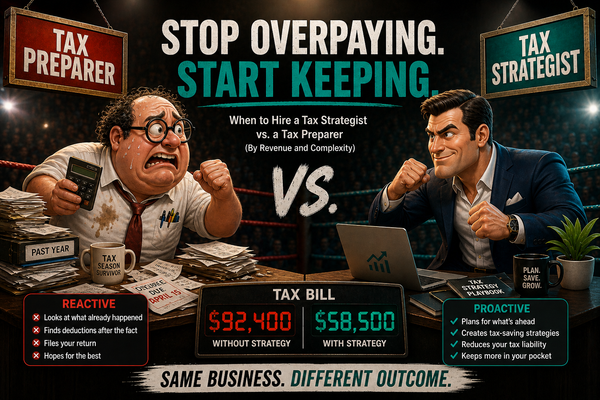
This is the biggest one. A generalist files your return. A specialist builds a tax strategy in Q1 and executes it throughout the year. They should talk about proactive strategy, not reactive compliance.
"Your CPA should spend more time talking about what you'll do next year than explaining what you did last year."
If they're only discussing the past, they're not a CPA—they're a tax preparer. There's a difference. A CPA can advise. A tax preparer just files.
Where to Look (And Where Not To)
Where to Look
- Industry Associations: Small business owner groups, chamber of commerce, industry-specific associations. These often have referral networks of CPAs who specialize in serving business owners.
- Your Network: Ask other business owners who their CPA is and whether they do proactive planning. Ask specifically: "Does your CPA initiate quarterly calls or do you have to ask?"
- CPA Firms with Small Business Practice Areas: Look for firms with dedicated small business or entrepreneurship departments—not firms where small business is 10% of their practice.
- CPA Associations and Directories: The AICPA (American Institute of CPAs) has a "Find a CPA" directory. You can filter by specialization.
Where Not to Look
- The Cheapest Option: A CPA charging $500 for a return is either inefficient or not thinking strategically. You're paying for volume, not analysis.
- The Solo Practitioner with No Specialization: They might be brilliant, but they also might be generalists who work alone because they can't build a team. Ask what percentage of their practice is small business and what systems they have for proactive planning.
- Tax Preparation Chains: H&R Block, TurboTax Live, etc. They file returns. They don't do strategy. You're paying for convenience, not expertise.
- The Big Four Accounting Firms: Deloitte, PwC, EY, KPMG focus on mid-market and enterprise clients. You'll be a tiny fish. You'll get a junior associate and a six-figure bill.
Look for mid-sized firms (5-20 CPAs) with clear small business focus and transparent about their approach to proactive planning.
Red Flags in the First Meeting
Your first conversation with a potential CPA should reveal whether they actually understand small business. Here's what to listen for:
- They talk about your tax return before asking about your business: A specialist asks about operations, structure, and goals before mentioning forms.
- They can't explain S-corp strategy in plain English: If they're vague about when it makes sense, they haven't thought it through.
- They quote a flat annual fee and that's it: No mention of quarterly planning, tax modeling, or proactive strategy conversations—this is a filing service, not a CPA.
- They use words like "probably," "maybe," or "we'll see": You want "Let me run the numbers" or "Here's the scenario we should model."
- They don't ask about your growth plans: A specialist asks "What's your revenue trajectory?" and "Are you planning to hire?" A generalist just wants to know your current numbers.
- They mention other clients vaguely or protectively: A specialist will reference similar situations (within confidentiality): "I work with several SaaS founders" or "Most e-commerce businesses I serve structure as S-corps." A generalist avoids specifics.
- They promise to "save you money" without asking questions: Red flag. They don't know your situation yet. Real specialists ask before they promise.
"In your first meeting, a red flag is worth more than a blue flag. Bad CPAs are more consistent than good ones."
Green Flags That Signal a Winner
- They ask about your business structure: Specifically about LLC vs. C-corp vs. S-corp, not just "What's your entity type?"
- They ask about your goals and timeline: "What's the business worth to you?" "When are you thinking about scaling or exiting?" These questions show they think strategically.
- They mention specific strategies relevant to your industry: If you're e-commerce, they bring up inventory accounting. If you're a service business, they mention equipment depreciation and home office optimization.
- They propose quarterly check-ins as standard: Not optional. Standard. This is how you build real tax strategy.
- They ask about cash flow, not just profit: These are different. A specialist knows that.
- They can explain their approach in plain English: No jargon unless necessary. They can say "Here's why an S-corp election would save you money in your situation."
- They have a clear process for new clients: Discovery meeting, analysis period, strategy session, implementation plan. Not just "Let's get last year's documents and I'll file your return."
- They reference relevant resources from their firm: Links to articles, tools, or calculators. S-corp savings calculators, planning guides, etc. This shows they invest in client education.
- They talk about "proactive strategy": Not just compliance. Strategy. There's a difference.
- They ask about deductions and tracking systems: "How are you tracking vehicle expenses?" "Do you have a home office?" "What business expenses are you currently capturing?" This shows they're thinking about optimization.
One green flag is nice. Three or four is a real signal that you've found someone who specializes in small business.
What to Expect From the First 90 Days
You've hired a good CPA. Here's what the first 90 days should look like:
Month 1: Discovery and Analysis
They gather all documentation, understand your business structure, and begin analyzing your 2024 return (or your current-year situation). They should ask clarifying questions about operations, deductions, and opportunities you might have missed. This is investigation mode, not filing mode.
Month 2: Strategy Development
They present findings. They should outline 2-3 opportunities specific to your situation—maybe an S-corp election opportunity, maybe deduction optimization strategies, maybe cash flow planning recommendations. These should be quantified. "This strategy could save you $8,400 annually" is better than "This could help."
Month 3: Implementation and Planning
You implement the low-hanging fruit. You establish quarterly planning calls. You set up systems for tracking deductions, capturing expenses, and reporting revenue. Your CPA should provide a calendar of upcoming tax deadlines and a framework for handling quarterly taxes. This is when the relationship becomes real.
If after 90 days you're still just talking about last year's return, you didn't find a specialist. You found another generalist.
Schedule a 30-Minute CPA Consultation
The Questions to Ask
When you're evaluating a CPA, use these questions in your first conversation:
- "What percentage of your practice is small business owners like me?"
- "Do you initiate proactive tax planning conversations, or do clients have to ask?"
- "Walk me through your process for a new client. What happens in month 1, month 2, month 3?"
- "Have you worked with businesses like mine? What strategies have you implemented for them?"
- "What does a typical quarterly planning call look like with you?"
- "How do you stay on top of tax law changes that could affect my business?"
- "What CPA services do you offer beyond tax filing?" (You want: entity structuring, strategic planning, quarterly consulting. You don't want: bookkeeping only, filing only.)
- "Can you give me a ballpark of what I should budget annually for CPA services?"
- "What's your take on S-corp elections for someone in my situation?"
Pay attention not just to the answers, but to how they answer. Do they think through your situation, or do they give generic responses? Do they ask clarifying questions, or do they assume they know what you need?
FAQ
Should I hire a CPA or a tax preparer?
This depends on your business complexity. A CPA can provide strategic tax advice and business consulting. A tax preparer just files returns. For a growing business, a CPA is almost always worth it. You're paying for strategy, not just filing.
How much should I expect to pay a small business CPA?
It varies by region and complexity, but expect $2,000-$6,000+ annually for a small business CPA doing proactive planning. That might sound high, but it's offset by the strategies they implement. A good CPA should save you more than their fee, often significantly.
What if my current CPA isn't doing proactive planning?
Talk to them. Ask directly: "Can we schedule quarterly planning calls?" If they're resistant or say "It's not really how we work," that's your answer. You might need to find someone who specializes in small business. This is one of the most important relationships in your business. It's worth getting right.
Can a small firm be better than a big firm?
Often, yes. A mid-sized CPA firm (5-20 people) with small business focus will likely give you more attention, more strategy, and better results than a solo practitioner or a huge firm treating you as a small fish. Look for specialization, not size.
Is it normal to change CPAs?
Yes. Many business owners realize after a year or two that their CPA isn't the right fit. If you're noticing signs your CPA isn't adding value, it's worth exploring alternatives. Your CPA should be a strategic partner, not just a vendor.
The Bottom Line
Your CPA is one of the three most important relationships in your business—alongside your lawyer and your banker. The difference between a generalist and a specialist often shows up on your tax return as thousands of dollars in savings (or missed opportunities).
A generalist CPA takes anyone with a pulse. A specialist CPA asks questions, models scenarios, and builds proactive strategy around your business. They cost about the same. The one you choose determines whether your business is overpaying taxes or optimizing them.
When you're interviewing CPAs, remember: you're not just looking for someone to file your return. You're looking for someone who understands your business, cares about your growth, and thinks three moves ahead about your tax situation.
Red flags matter more than credentials. Green flags matter more than prices. And a specialist CPA matters more than a generalist one.
Take your time. Ask the right questions. Find the right fit. Your business will thank you—usually in the form of money you didn't lose to unnecessary taxes.