10 Signs Your CPA Is Costing You Money (Even If They're 'Nice')
A friendly CPA and a good CPA aren't always the same thing. Here's how to tell the difference.


Your accountant is responsive. They're polite on the phone. They get your return filed on time. So what's the problem?
The problem is that "nice" and "effective" aren't the same thing. A CPA can be perfectly pleasant to work with and still leave tens of thousands of dollars on the table every year. You'd never know, because the money you're losing is money you never saw in the first place.
Here are ten signs your current accountant is costing you more than they should.
1. You Only Hear From Them During Tax Season
If your CPA disappears from February to January, that's not a tax advisor — that's a tax preparer. There's a significant difference.
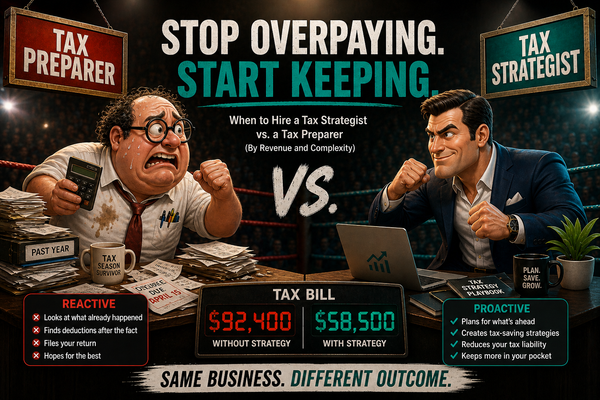
Tax preparation is backward-looking. It records what already happened. Tax planning is forward-looking. It changes what's going to happen. The strategies that save real money — entity elections, retirement plan contributions, income timing, estimated payments — all require decisions made during the year, not after it ends.
A CPA who only shows up at filing time can't help you with any of that. They're documenting your tax bill, not reducing it.
"The money you're losing is money you never saw in the first place."
2. They've Never Mentioned an S-Corp Election
If you're a business owner earning more than $60,000 in net profit and your CPA has never brought up an S-Corp election, something is wrong. Not because an S-Corp is right for everyone — it isn't — but because it should at least be part of the conversation. (Not sure which structure is right for you? See our LLC vs. S-Corp breakdown.)
The S-Corp election can save business owners $10,000 to $30,000 or more per year in self-employment taxes. A CPA who doesn't proactively raise this topic either doesn't understand it, doesn't think about your tax situation strategically, or isn't paying close enough attention to your numbers. You can estimate your own savings with our S-Corp savings calculator.
Any of those explanations should concern you.
3. You Don't Receive a Tax Plan or Projection
Ask yourself: has your CPA ever given you a written document — not a return, but a plan — that outlines what strategies are available to you and how much they'd save?
Most business owners and high-income earners have never received one. They assume that's normal. It isn't. A tax projection mid-year tells you where you're headed. A tax plan tells you what levers you can pull before December 31st. Without both, you're flying blind.
If you're paying $3,000+ for tax preparation and the only deliverable is a filed return, you're paying for the least valuable part of the relationship. Learn more about why tax planning matters.
"A filed return is the least valuable part of the relationship."
4. They Bill by the Hour
Hourly billing creates a perverse incentive: the more complex your situation, the more your CPA earns. There's no reward for efficiency and no motivation to simplify your structure or streamline processes.
Worse, hourly billing discourages you from calling with questions. You start self-censoring. "I'll just figure this out myself" becomes your default — and that's exactly when expensive mistakes happen.
The best CPA firms use flat-fee or fixed-scope pricing. You know what you'll pay. They know what they'll deliver. Everyone's incentives are aligned. (Curious about the difference? Read CPA vs. tax preparer.)
Wondering what you might be overpaying?
5. They Don't Ask About Your Business Goals
Tax strategy doesn't exist in a vacuum. If your CPA has never asked about your plans — are you hiring? Buying property? Considering a sale? Taking on a partner? — they can't possibly give you relevant advice.
A good tax advisor wants to know where your business is going because every major decision has a tax consequence. Buying a building triggers depreciation decisions. Hiring your first employee triggers payroll structure decisions. Planning to sell in three years triggers entity and basis planning now.
If your CPA treats your return like an isolated math problem, they're missing the context that actually matters.
6. Your Quarterly Estimates Feel Like Guesswork
Some CPAs calculate quarterly estimated payments by taking last year's tax and dividing by four. That's a shortcut, not a strategy.
If your income is growing, that safe harbor calculation might not cover your actual liability — and you'll get hit with underpayment penalties. If your income dropped, you're overpaying the IRS and lending them money interest-free.
A proactive CPA runs projections throughout the year and adjusts your estimates based on actual performance. Your quarterly payments should feel precise, not approximate.
7. They Don't Know Your Industry
Tax law isn't one-size-fits-all. A physician running a private practice has different planning opportunities than a real estate investor, which is different from an agency owner with 1099 contractors.
Industry-specific strategies — like Real Estate Professional Status for investors, or accountable plans for physicians — are where the biggest savings live. A generalist CPA who works with anyone from Uber drivers to hedge funds is unlikely to have deep expertise in the nuances that matter most for your situation.
When your CPA doesn't know your industry, they default to generic advice. Generic advice doesn't move the needle.
"Generic advice doesn't move the needle."
8. They've Never Reviewed Your Entity Structure
You formed an LLC three years ago because someone told you to. Since then, your revenue has tripled and you've hired two employees. Has your CPA revisited whether your current structure still makes sense?
Entity structure isn't a set-it-and-forget-it decision. As your income, expenses, and business complexity change, the optimal structure often changes with it. Maybe you should have elected S-Corp status two years ago. Maybe you need a holding company. Maybe your single-member LLC is exposing you to unnecessary risk. (Use our LLC vs. S-Corp decision tool to see where you stand.)
If your CPA hasn't raised this topic in the last two years, it's probably not on their radar.
9. They Can't Explain Your Return to You
If you can't look at your tax return and understand — in plain language — where your money went, something is off. Either the return is sloppy, your CPA isn't communicating clearly, or both.
You should be able to ask "why was my tax bill higher this year?" and get a specific answer. Not "well, you made more money," but something like "your W-2 income pushed you into the 35% bracket and your rental losses were limited by passive activity rules."
A CPA who can't — or won't — explain your return clearly isn't treating you like a client. They're treating you like a file number.
10. You've Never Been Told "No" or Challenged
Here's the counterintuitive one. A good CPA should occasionally push back on your ideas. If you say "I want to deduct my vacation as a business trip" and they just do it without questioning you, that's not being helpful — it's being compliant. And compliance without judgment puts you at risk.
The CPAs worth paying for are the ones who say things like: "You can do that, but here's why I wouldn't recommend it." Or: "Actually, there's a better approach that saves you more and has lower audit risk."
A CPA who agrees with everything you say isn't advising you. They're taking dictation.
Recognize three or more of these signs?
What to Do if You Recognized Yourself
If three or four of these hit close to home, you're not alone. Most business owners don't know what a proactive CPA relationship looks like because they've never experienced one.
The good news is that switching doesn't have to be complicated. You don't need to wait until the end of the year. You don't need to have an awkward conversation. You just need to find someone who treats your business like it matters — not just at tax time, but all year. Here's exactly how to make the switch.
FAQ
How do I know if my CPA is actually saving me money?
Ask them directly: "What strategies did you implement this year that reduced my tax liability?" If they can't point to specific actions — like an entity election, retirement plan optimization, or income timing strategy — they're likely just filing what you give them, not actively planning.
What's the difference between tax preparation and tax planning?
Tax preparation is recording what already happened and filing your return. Tax planning is making forward-looking decisions during the year — like adjusting estimated payments, timing income and deductions, or restructuring your entity — to reduce your future tax bill. The biggest savings come from planning, not preparation.
Should my CPA be reaching out to me during the year?
Yes. A proactive CPA should be contacting you at key points — before quarterly estimated payments, ahead of year-end for planning, and whenever tax law changes affect your situation. If the only time you hear from them is when they need your documents, that's a red flag.
Is it worth paying more for a specialized CPA?
In most cases, yes. A CPA who specializes in your industry or situation (business owners, physicians, real estate investors) will know strategies that a generalist won't. The fee difference is almost always smaller than the tax savings a specialist uncovers.
Can I switch CPAs if my current one already filed an extension?
Absolutely. Your new CPA can pick up the engagement and file before the extension deadline. There's no obligation to stay with the CPA who filed the extension.
Curious what a proactive tax relationship looks like? Book a free introductory call with our team. No pressure, no pitch — just a straightforward conversation about where you stand and what you might be missing.